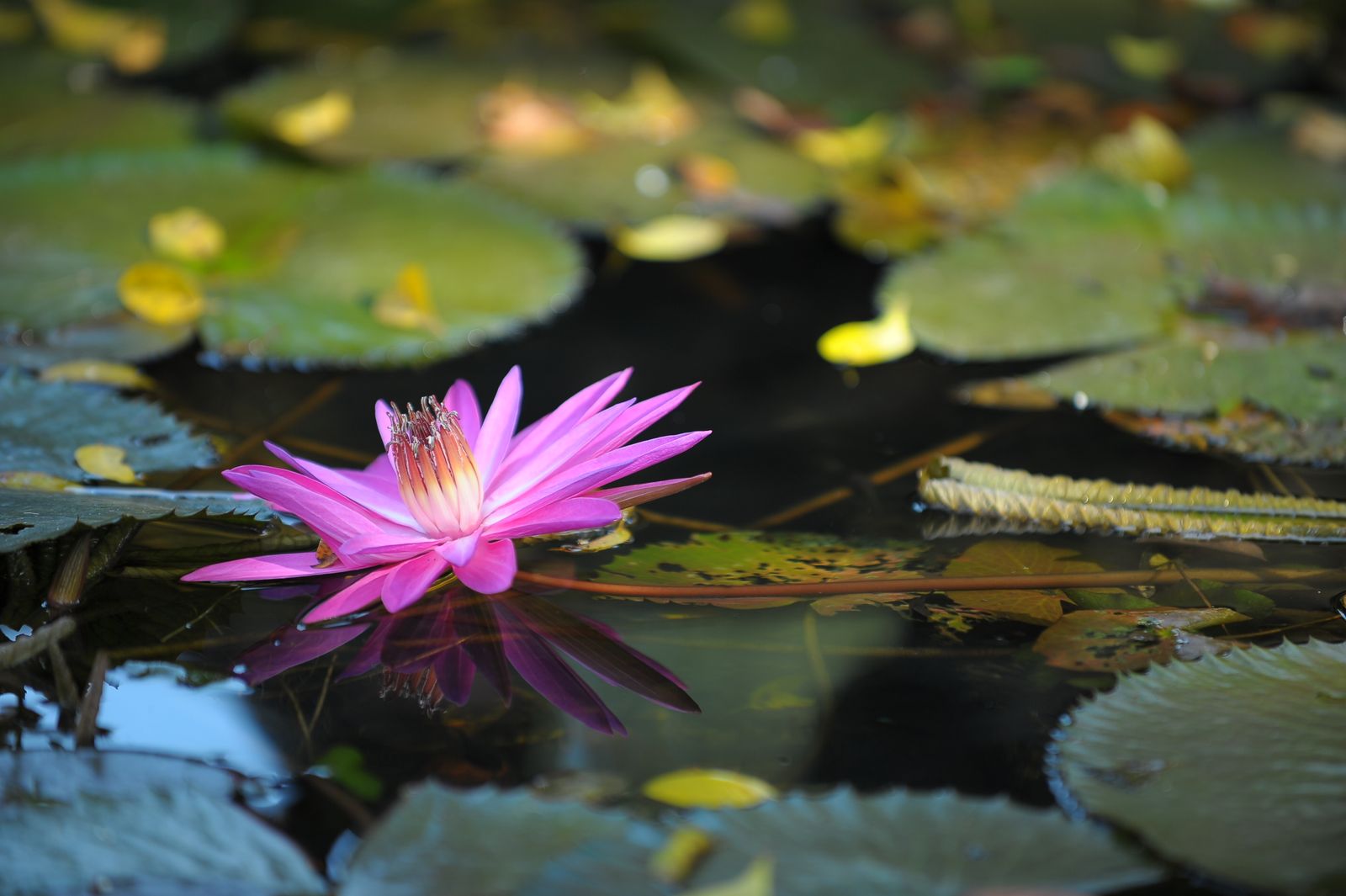
A seated figure. Seven coloured circles. Red at the base, violet at the crown. Beside each circle, a life theme: security, sexuality, confidence, love, communication, intuition, spiritual connection.
You have probably seen the picture so often that it no longer looks like an interpretation. It looks like the thing itself.
But a rainbow is not a bibliography.
Chakra teachings have genuine Indian roots. The familiar package of rainbow colours, psychological categories and matching wellness products is not an unchanged ancient system handed down intact. It has a history of translation, reinterpretation and recombination.[1][4]
Understanding that history does not require us to ridicule anyone's experience. It asks us to become more precise about what we are practising, where it comes from, and what claims we make on its behalf.
India did not have only one chakra map
The Sanskrit word cakra can mean wheel or circle. In different tantric contexts, bodily centres appear within systems of practice involving attention, mantra, visualisation, deities and elements. Hindu and Buddhist traditions do not all describe the same number, arrangement or function of centres.[1]
That diversity is not an unfortunate mistake waiting for a modern poster to correct it. It tells us that a chakra diagram belongs to a context.
A map used for one contemplative or ritual purpose need not be identical to a map used for another. To understand either, we should ask what its practitioner is instructed to do, not simply count the circles and choose the most familiar picture.
This is the first important correction: there was no single universal chart representing everything that every Indian tradition taught about the subtle body.
The opposite oversimplification is also wrong. It would be inaccurate to claim that Western writers invented chakras, or that Indian traditions knew nothing of colour or seven-centre arrangements.
What an actual Sanskrit text shows us
One influential example is Pūrṇānanda's sixteenth-century Ṣaṭ-cakra-nirūpaṇa, a description of six centres that also discusses the thousand-petalled lotus above them. The work belongs to the Śrītattvacintāmaṇi, dated to 1577. It is an important witness to a tradition, not the first moment in history when anyone imagined centres in the body.[1][2]
Its descriptions are much richer than one colour and one personality keyword.
Verse 4 describes the root lotus with four crimson petals and luminous letters. Verse 22 describes the heart lotus with twelve letters, the colour of the bandhūka flower, and a smoke-coloured region associated with the air element. In Kālīcaraṇa's commentary, the instruction to meditate upon the lotus is made explicit.[2]
Notice what this does and does not establish. Colour is certainly present. So are letters, geometrical forms, elements and a practice context. But we are not looking at the simple rule “heart equals green” as an unquestioned universal fact.
It also matters which component of an image is being described. The petals, an elemental region, a deity and a mantra may have different colours. Compressing all of that into one coloured dot is already an act of interpretation.
A careful reader can appreciate the beauty of the original imagery without pretending it is a modern anatomical diagram.
Translation made one map much more visible
In 1919, Sir John Woodroffe, writing as Arthur Avalon, published The Serpent Power. Its translated materials, including the Ṣaṭ-cakra-nirūpaṇa, helped make a particular body of tantric teaching accessible to English-language readers.[2][3]
Translation is a major part of this story. So is selection. When one text becomes especially accessible and widely discussed, its framework can come to stand for a much larger and more varied tradition in the minds of new readers.
That does not make the translation worthless. It means we should distinguish “an influential account of chakra practice” from “the one original system behind every tradition.”
Nor should Woodroffe be confused with every later author who wrote about chakras. Translation of a Sanskrit text, a clairvoyant account, a psychological interpretation and a modern self-help manual are different kinds of work. Their covers may use related imagery; their methods and claims are not therefore interchangeable.
How the Western synthesis took shape
C. W. Leadbeater's The Chakras, first published in 1927, belongs to the Theosophical strand of this history. C. G. Jung's 1932 seminars approached kuṇḍalinī symbolism through psychological interpretation; the edited seminar notes were later published as The Psychology of Kundalini Yoga.[3][5]
These are not simply further editions of Pūrṇānanda. They represent different ways of reading and describing subtle-body material.
Christopher Hills's Nuclear Evolution, with an expanded second edition titled Nuclear Evolution: Discovery of the Rainbow Body in 1977, is another part of the modern colour-and-consciousness story.[6]
Historian Kurt Leland identifies Ken Dychtwald's 1977 Bodymind and related Yoga Journal article as an important synthesis bringing rainbow colours together with psychological qualities circulating in the human-potential movement. Leland's account traces multiple contributors and several decades of development, rather than a single ancient chart being transferred unchanged to the modern world.[4]
Later, Anodea Judith's Wheels of Life, first published in 1987, presented a modern approach that explicitly used new metaphors and applications.[7]
The responsible conclusion is not “one person invented the chakras in 1977.” It is that the now-familiar Western package emerged through a process. Its ingredients have different ages and different sources. Putting a Sanskrit word at the top of the finished chart does not make every association beneath it equally ancient.
What changed when the map became psychological?
The emphasis can shift considerably when a system of mantra, deity visualisation and contemplative transformation is presented primarily as a sequence of personal-development themes.
A reader may now approach the root through questions about security, the heart through relationships, and the throat through self-expression. Those questions can be meaningful. But their usefulness does not, by itself, tell us which Sanskrit text teaches that exact scheme.
We should also avoid claiming that traditional Indian teachings were uninterested in the mind or inner experience. That would be another historical distortion. The issue is more specific: the familiar modern list of psychological correspondences should not automatically be attributed to every older chakra system.
My concern is not that interpretation has happened. Living traditions have always required interpretation. My concern is that the interpretation can become invisible, leaving the reader unable to distinguish an older teaching from a recent addition.
And then the chart became a shopping list
A neat seven-part diagram is easy to turn into a product range. Seven stones. Seven oils. Seven candles. A purchasable response to every supposed blockage.
This is my reading of the commercial appeal of the model, not an allegation that every teacher or author set out to deceive people. A simple chart gives an unfamiliar subject a memorable structure. It also makes it easy to imply that a complex human difficulty has a conveniently colour-coded solution.
Here is the question worth asking: have I been given a practice, an interpretation, or a product description?
The answer matters. A pleasant scent is not proof that a particular chakra has been repaired. Feeling comforted by a stone does not establish the age of its advertised correspondence. And a difficult conversation may require honesty and support, rather than another object assigned to the throat.
You can enjoy something without claiming more for it than you know.
Symbolic maps are not medical diagnoses
Another common move is to place chakras beside glands or nerve plexuses and treat the resemblance as scientific confirmation.
An analogy is not the same as evidence. These comparisons should not be presented as though the subtle-body model has thereby become established human anatomy. Nor should symptoms be confidently attributed to an energetic blockage instead of receiving appropriate assessment.
A traditional contemplative framework can be studied on its own terms. It does not become more trustworthy through medical-sounding claims that have not been demonstrated.
The same care applies to practice. Forceful attempts to produce dramatic “awakening” experiences are not required in order to learn this history or begin a thoughtful study of yoga. Do not use a chart as a reason to override pain, distress or professional healthcare advice.
Better questions than “Which chakra is blocked?”
Start with the source. Which text or lineage is being taught? What does it actually say? Is the teacher distinguishing translation from their own explanation?
Then ask about the method. What are you being invited to practise, for what purpose, and with what preparation? Is there appropriate guidance, or only a description of spectacular results?
Finally, ask about the claim. Is it historical, symbolic, spiritual or medical? What would count as support for it? Those categories should not be quietly exchanged whenever one of them becomes difficult to defend.
These questions need not make you cynical. They can make you a better student. Reverence and discernment are not enemies.
Beyond the poster
The history of chakras is more interesting than the claim that everything familiar is ancient. It is also more interesting than the claim that everything unfamiliar must be nonsense.
There are Indian texts, diverse traditions, demanding practices, thoughtful translations, imaginative reinterpretations and commercial simplifications. We lose something when we flatten all of them into the same colourful picture.
Keep your curiosity. Keep your capacity for wonder. But let a teaching earn its historical claims, and let a practice be more than its packaging.
To study real yoga, its sources and its living practice, join The Living Tradition. We begin with the texts and the questions they raise—not with the assumption that a familiar poster has already answered them.
Sources and reading
[1] Christopher Wallis, The Real Story on the Chakras (2016), on the diversity of traditional systems and their practice contexts. This article does not adopt the overbroad claim that all psychological associations are exclusively modern or Western.
[2] Pūrṇānanda, Ṣaṭ-cakra-nirūpaṇa, especially verses 4 and 22, with Kālīcaraṇa's commentary, translated by Arthur Avalon. The text describes six centres and the thousand-petalled lotus; it is not being presented as the first-ever seven-centre model.
[3] Arthur Avalon, The Serpent Power (1919); C. W. Leadbeater, The Chakras (1927). These works represent different kinds of engagement with chakra teachings.
[4] Kurt Leland, Rainbow Body: A History of the Western Chakra System from Blavatsky to Brennan (2016), and The Rainbow Body: How the Western Chakra System Came to Be. The identification of Dychtwald's 1977 synthesis is attributed to Leland's historical account, not presented as a single invention date for chakras or chakra colours.
[5] C. G. Jung, The Psychology of Kundalini Yoga: Notes of the Seminar Given in 1932, edited by Sonu Shamdasani, Princeton University Press, 1996.
[6] Christopher Hills, Nuclear Evolution: Discovery of the Rainbow Body, second edition, 1977.
[7] Anodea Judith, Wheels of Life: A User's Guide to the Chakra System, first published 1987. Historical publication dates should not be confused with endorsement of every claim made in these books.